

(CNN)President Donald Trump and presumptive Democratic nominee Joe Biden are unleashing the first shots over China and the coronavirus pandemic that could turn into a critical showdown in November's election.
Trump
has now turned on China, where the pandemic originated, as an apparent
distraction from domestic criticism of his slow recognition of the
crisis that has now killed more than 42,000 Americans. But he is also
exposed by his repeated flattery
of President Xi Jinping's management of the virus. So, as he often
does, the President is adopting attack as his best form of defense,
slamming Biden for what he claims is a long record of appeasing Beijing.
But the former vice president is hitting back with an extremely stark digital ad that claims "Trump rolled over for the Chinese. He took their word for it."
The
attack previews a searing accusation likely to dominate the fall --
directly blaming millions of lost jobs and tens of thousands of US
deaths on Trump, who the ad says left America "unprepared and
unprotected."

It
is a sign of the disjointed, globalized times that a virus that first
emerged in a city in central China unknown to most Americans could
potentially define a US presidential election.
But
the President's struggle to find an exit from the worst domestic crisis
since World War II -- exacerbated by a series of missteps bound up in
his dealings with Beijing -- will likely decide his fate in November.
The
conflagration over China is also consequential because it's about far
more than the virus. It lays bare the differing temperaments, worldviews
and economic and political instincts of the rivals.
And
US-China relations crystalize multiple forces shaping American politics
-- industrial blight in Midwestern electoral battlegrounds, trade wars,
Trump's America First nationalism, the challenge to US influence in
Asia and the President's climate change denial.
But
whoever wins the political confrontation over China, one thing is
clear: It will cause a further deterioration of what experts say is the
world's most important economic, diplomatic and security relationship.
Trump's China gamble
Trump's
early attack on Biden over China -- while it may prove effective, given
his skills at hammering home a negative narrative -- is also risky
because it reveals his own political liabilities.
The
President's weeks of praise for Xi, who appeared to initially use
autocratic might to hide the extent of the pandemic, leave him open to
charges of hypocrisy.
"China has
been working very hard to contain the Coronavirus," Trump tweeted on
January 24, a period in which he now accuses the World Health
Organization of colluding in a cover-up with Beijing.
"The
United States greatly appreciates their efforts and transparency. It
will all work out well. In particular, on behalf of the American People,
I want to thank President Xi!"

Trump's
2020 campaign is trying to turn a weakness into a strength, blistering
Biden with ads that claim that he, not Trump, went soft on Beijing.
"China wants Sleepy Joe sooo badly," Trump wrote in a tweet magnifying the campaign on Saturday.
"They
want all of those billions of dollars that they have been paying to the
U.S. back, and much more. Joe is an easy mark, their DREAM CANDIDATE!"
Trump
has made his tough approach to China a signature of his presidency,
launching a tariff war that dismayed the Republican Party's traditional
free trade lobby and raised prices for US consumers.
But
China has also exploited Trump's reversal of US engagement to multiply
its influence -- especially after the US backed out of the Trans-Pacific
Partnership trade pact, an attempt to balance Beijing's growing
economic power.
Trump's two-sides China policy: Bash Beijing while praising Xi
Trump's
powerful allies in conservative media are already highlighting
Beijing's failings at a time when more objective outlets are also
dwelling on Trump's mistakes.

The President has engaged with questions about conservative claims that the virus spread
from a Chinese laboratory, not a live animal market -- despite a lack
of conclusive intelligence so far that is the case. Like Trump, China
has tried to deflect from its own culpability by playing politics, but
it is also giving the President ammunition. He seized on a conspiracy
theory floated by a Foreign Ministry official that US troops took the
virus to China in order to accuse Beijing of acting in poor faith.
Bashing
China is a tradition in US presidential elections: Bill Clinton, for
instance, slammed President George H.W. Bush for coddling the tyrants in
Beijing, then as president took expansive steps to encourage their
economic emergence.
Trump turned
the tactic into a political art form in 2016, accusing China of "raping
our country" -- an effective message in Midwestern swing states gutted
by the flight of jobs abroad.
A
battle for Rust Belt voters in states like Pennsylvania, Michigan and
Wisconsin could decide the election in 2020 and the President will
trumpet his efforts to stand up to China.
Trump transformed US-China policy
Unlike
many of Trump's political attacks, his critique of China does bear some
relation to the truth and attracts some bipartisan support.
Many
nations have questions over China's reaction to the outbreak of the
coronavirus and about the transparency of its case counts even now.
Singling
out Beijing plays into another Trump campaign play -- the idea that a
foreign force is threatening US life and culture. In 2016 Mexicans
played that role. Now it's China's turn, raising concerns about a
backlash against Americans of Asian origin.

A
new Trump campaign ad accuses Biden of standing up for China while
"China cripples America," showing clips of the former vice president
saying it is in US interests that China prospers.
A
pro-Trump super PAC, America First Action, is blasting "Beijing Biden"
in a $10 million ad across swing states Wisconsin, Michigan and
Pennsylvania.
Trump's ad distorts
and takes some of Biden's positions out of context. But the President's
team can fairly argue that Biden is a veteran of a previous era of
Sino-US relations, when successive presidents saw a need to manage
Beijing's rise to avoid a confrontation that now seems increasingly
likely.
Critics of that approach on
both sides of the aisle now say it empowered a US future enemy. And
Trump engineered the most significant pivot in nearly 50 years of
US-China relations.
The President
can also justifiably argue that previous US administrations, including
the one in which Biden was vice president, did not prevent Beijing's
trade abuses and intellectual property theft.
Biden,
as a senator from Delaware, voted to grant China permanent normal
trading relations during the Clinton administration -- a move that
unleashed the Asian giant's economy but also added to the rush of US
manufacturing jobs abroad. That gives Trump the chance to argue Biden
was complicit in the "American carnage" that resulted, in an effort to
undercut the Democrat's strong blue-collar support.
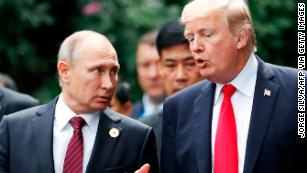
The China attack also has another attraction for the President.
Trump
last year called on Beijing to launch an investigation into Biden and
his son Hunter, alleging they had received a Chinese payoff worth
billions of dollars.
A company on
whose board Hunter Biden later sat received a large investment of
Chinese capital shortly after he had visited the country with his
father. Hunter Biden's lawyer said his client had received no
compensation for being on the board of the firm, BHR, has not received
any return on his investment and there have been no distributions to BHR
shareholders since he obtained his equity interest after the vice
president left office.
But as Trump
showed in his assault on Democratic presidential nominee Hillary
Clinton in 2016, just the taint of impropriety and questions about
conflict of interest can give him an opening, despite his own opaque and
extensive business dealings, which he has tried to keep from the
American people by refusing to release his tax returns.
Biden can turn Trump's attacks against him
The
great weakness of Trump's China assault on Biden is embedded in his own
campaign ad, in which the former vice president is pictured clinking
glasses with Xi.
Every time he is
attacked, Biden can raise the long list of occasions when Trump poured
praise on China's management of the coronavirus pandemic.
"I
just spoke to President Xi last night," Trump said in North Carolina on
February 7. "But I think he's going to handle it. I think he's handled
it really well. We're helping wherever we can. But we have a great
relationship. It's incredible."
The
President has since tried to heap blame on China and the WHO as
criticism escalated that he disastrously underplayed the threat from the
virus.

"I
was very happy with the deal, very happy with everything, then we find
out about the plague, right? The plague. And since we found out about
that, I'm not happy," Trump said on Sunday, repeatedly touting what he
calls his China travel ban brought into force at the end of January. The
President restricted entry from foreign nationals who had recently been
in China. But an estimated 40,000 other people entered the US after
recent travel in the country following the imposition of the
restrictions.
The Biden campaign
reacted swiftly to Trump's escalation and is also skewering the
President on the "phase one" trade deal under which Beijing agreed to
increase US agricultural purchases from the US in return for a halt to a
$250 billion US tariff hike on imports from China.
The
pact did not lift most tariffs hurting US consumers but did improve
some access to US produce and banks in Chinese markets. Key issues like
intellectual property theft remain unresolved. however.
"President
Trump's false attacks on Vice President Biden are just another attempt
to distract from the president's failure to stand up to China for
American workers and more importantly, more immediately today his
failure to prepare our country for the coronavirus pandemic," Democratic
Sen. Sherrod Brown of Ohio, a Biden supporter, told reporters Friday.
0 Comments